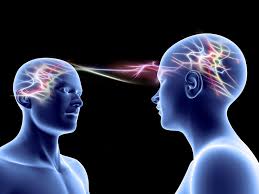
Okay, so I have been a bit teasing about the actual nature of telepathy in previous posts, claiming that, since we do not understand mental concepts very well (such is Philosophy, after all), it follows that we do not know that telepathy is impossible, a gigantic hoax, or something of the same order as human spontaneous combustion, turning water into wine, and so forth.
However, the positive sceptical response (there is such a thing) is that belief in telepathy is just wishful thinking, which is something that all Good People know to be a Bad Thing. We talk of Psychical Research, Parapsychology, and more generally, about the Paranormal. The simple fact is that all such things are mere tosh, the sort of drivel believed only by the half-educated – or by those educated well beyond their ability to undertake analytical thought (as I once heard it put).
Well, we shall see, shall we not? Firstly, again, some definitions are needed: just what do we mean by the ‘paranormal’? A brief look at the Wikipedia article on that subject yields the following preface:
This article is about unexplained phenomena. For phenomena not subject to the laws of nature, see supernatural. For unexplained but presumed natural phenomena, see preternatural. For other uses, see Paranormal (disambiguation). [And so on]
Okay, so we hit our first stumbling block. That telepathy is not an explained phenomenon is hardly news, so the sceptic seems to have crashed at the first hurdle. End of story?
No, the scientifically-minded sceptic continues, unvexed by what looks to her like a rather silly piece of logic-chopping, we shall just say that there are no supernatural phenomena – a fortiori, no telepathic supernatural phenomena. Forms of communication that look mysterious to start off with, but then turn out to have a perfectly logical explanation (such as conjuring tricks) do not count. That is not what we are talking about.
Mentalists (often husband-and-wife teams, for obvious reasons) can communicate detailed information in a way that makes them ineligible to be bridge-partners. Just how they manage to do this, using only utterly innocent phrasings and gestures, is truly wonderful, but of course, it is not inexplicable – neither paranormal, supernatural nor preternatural. Just very, very clever. And they therefore will not count as telepaths, when the word is correctly used. Or so the sceptic insists.
So what alleged phenomenon is ruled out? The danger here is that saying that telepathy is impossible (the sceptic’s desired conclusion) is going to turn out to be an example of what Kant called an analytic judgement. The predicate is contained within the subject: that is to say, impossibility is simply built into the definition of the word ‘telepathy’. Proving that telepathy is impossible in a scientifically rigorous way (perhaps by very careful empirical testing) thus turns out to be just as silly an activity as an elaborate field survey of bachelors to test the hypothesis that there are no married bachelors.
The fact is that the sentences ‘Telepathy is impossible’ and ‘Bachelors are unmarried’ are (it would seem) both true by definition: their denials amount to self-contradiction, and we do not need scientists with their clean white coats, gleaming laboratories and ludicrously over-funded research councils to tell us this.
In other words, the sceptic has been outsmarted by the philosopher – yet again.
Okay, time to take the gloves off, sayeth mine enemies. This is for starters:

The full website of the Koestler Parapsychology Unit may be found at https://koestlerunit.wordpress.com/
Now, this is not something I made up. There are real academics working here, and to debate whether their alleged subject matter is real or not is emphatically not a trivial issue.
Of course, it could be made to seem otherwise. Another questionable discipline is exobiology, now a part of astrobiology, which investigates life outside the Earth. It has the drawback that nobody (yet) knows whether it actually has a subject matter. Now, you could simply define ‘life’ is a sufficiently narrow way as to make the phrase ‘extraterrestrial life form’ into a contradiction in terms, but that would be visibly silly.
Note, though, that the question of whether a machine could ever be given life (made empsuchos, to use the ancient Greek term) has seemed to some philosophers to be quite obviously impossible, and that Artificial Intelligence (AI) is a contradiction in terms. Cognitive scientists get a bit bothered by this sort of thing, and who can blame them?
Of course, the human body is a kind of machine, as the father of the mechanical philosophy (one René Descartes), so brilliantly pointed out, thus enabling us to break away from mediaeval superstition and create Science as we know it.
As you can see, the very idea that our pineal glands should be haunted by ghosts whose modus operandi are supernatural is so silly that only the Princess Elisabeth of the Palatinate would entertain the thought.
Okay, okay, I desist. For the moment. I shall shortly explain to you the ins and outs of the Ganzfeld experiments, and so forth. But first, some extraterrestrial music …
Now, supporters of parapsychology refer to the unknown non-physical force that underpins paranormal activity as psi, the 23rd letter of the Greek alphabet, also written as ψ. This has a reassuringly mysterious quality, for not only is it the first letter of the Greek word psyche (or psuche), it is also the symbol used to signify the mysterious carrier of pure information that plays a central role in Quantum Mechanics, a theory that completely upsets all our ordinary intuitions about what is physically possible.
The Parapsychological Association divides psi into two main categories: psi-gamma for extrasensory perception and psi-kappa for psychokinesis. The former concerns atypical world-on-mind activity, the latter atypical mind-on-world activity. They each involve slightly different problems, so I shall examine them separately.
But first, some slightly less martial music for a change.
Now, in the ur-article, as I call it, I mentioned the fact that many people on the autism/Asperger’s spectrum have only a rudimentary theory of mind. That is to say, they cannot easily work out what other people think and feel – at least not in the direct sort of way that the rest of us can. Such people can be highly intelligent and care deeply about the welfare of others. And some say that this condition is not a defect but a gift, one where a certain single-mindedness and disinclination to be distracted by life’s little frivolities can lead to greatness.
However, this gift comes at a price. One person with this condition (I forget who) explained her bafflement when trying to negotiate the school playground. It seemed that her classmates had telepathic links with each other, and could communicate directly and unconsciously, whereas she had to theorize laboriously to predict accurately what they were going to do next.
What most of us can do is simulate others’ mental states. This is sometimes described as taking on the other states and making ‘quick and dirty’ inferences from them whilst they are ‘off-line’. The term co-cognition is also sometimes used here, and it is clearly related to Collingwood’s conception of re-enactment.
We thus work out what other people are going to do by imagining ourselves to be in their shoes. This imaginative leap is instinctive, automatic and not calculated. Autistic people, by contrast, either live in an isolated mental reality all on their own and just cannot function in society at all (if they are on the far end of the spectrum), or else have to make more explicit deductions and try just that bit harder (if they have compensating intellectual qualities, and are on the near end of the spectrum).
Do autistic people understand ordinary mental concepts such as belief and desire? Some of them can certainly use the relevant words correctly, but (pace Wittgenstein), this may not be sufficient. There are congenitally blind people who have never seen colours, but who can nevertheless give convincing lectures about colour vision, visual art and related matters. Do they know what ‘red’ means despite never having seen red, or being able to imagine what a visual sensation of redness (or of anything else, for that matter) is like? Yes and no is our instinctive answer. It is a tricky one.
Now, it has been said that physiology is different from anatomy in that there can only be deficits from normal functioning, and no excesses. For example, normal vision, so called, is not typical vision but perfect vision, one without any defects such as long-sightedness (hypermetropia), short-sightedness (myopia) and so forth. You cannot get better than a perfectly formed lens, whether it be of the eye itself or of custom-made spectacles.
True, Superman can read a car number plate a mile away, and there was once a comic character called Billy Binns who had magical spectacles that would enable him to perform remarkable feats (like tightrope walking). However, we suspect a trick somewhere, and that any such extraordinary talents would require brain functioning that led to deficits elsewhere.
But where there is the negative prefix ‘a-‘, there is also the ‘hyper-‘ prefix instead. Amnesia (poor memory) is common enough, and extreme hypermnesia (the ability to remember almost everything) very rare, but the fact is that it is possible. Physiology is not quite what it seems, and there can – sometimes – be excesses as well as deficits.
You can see where I am going with this idea. Is there a conceivable condition, call it anti-autism, which relates to normality as normality relates to autism? We cannot coherently describe such a condition, because we lack the concepts. But if autists were to declare, for a similar reason, that normality was conceptually impossible, we can see that they are just plain wrong. This would remain so even if they were a powerful majority (this could happen if some disaster were to befall humanity).
Ditto our suspicion of anti-autistic people should we meet them (perhaps we would be inclined to burn them, as we used to do to so-called witches).
So, how do telepaths differ from anti-autistic people? I don’t think we can say that they have to be different at all, still less because the former are (allegedly) conceptually impossible in the way in which the latter are not. Our concepts are just not transparent enough for us to be able to make such confident judgements.
Some more thoughtful music is needed now. This opening chord has a brooding quality largely because it is a G minor. Why? The middle note of the triad, that which makes it a minor chord, is a B flat which is a tritone away from an E, the furthest possible musical distance. This is significant since most rock music is guitar based, and guitars are tuned with E at the highest and lowest pitched strings. The chord itself therefore commands attention, and delivers the message that something very new and very different is to about to be heard.
It may still be felt that the essence of telepathy, of this particular species of clairvoyance, is being wilfully misrepresented. The relevant claim is that information can pass from one person to another with no physically explicable method of transmission, and no amount of anti-autism is going to achieve that.
Okay. So what repeatable-cum-falsifiable set of experiments are we talking about? What you are probably thinking about right now (!) are experiments involving what are called Zener cards, depicted below.

By Mikhail Ryazanov (talk) 01:30, 1 April 2014 (UTC) – File:Cartas Zener.svg + File:Zenerkarten c.jpg, CC BY-SA 3.0, https://commons.wikimedia.org/w/index.php?curid=31927664
You can guess what sort of experiments are involved. The subject has to guess what card is being looked at, and there is no physically possible method of communication between subject and experimenter. The results, needless to say, are not conclusively positive. Most people say they are negative.
Why ‘needless to say’? Well, if there really were any significant evidence in favour of psi-gamma, you would have already heard about it. Every scientist in the world would be shouting the fact from the rooftops. They would not merely whisper it among themselves in embarrassment.
So, I see you grin confidently, that’s an end on the matter, isn’t it?
Actually not. We still have to analyse what is meant by ‘no physical communication’, and there remains the residual suspicion that the sceptic has loaded the cards against the believer. Let me explain.
Physicists now recognize four fundamental forces in the physical universe. They are: the strong nuclear force; the weak nuclear force; the electromagnetic force; and, finally, gravity. The latter is a special case, and is explained primarily by spatiotemporal curvature. That is to say, the curved trajectory of a body subject to a gravitational force is seen instead as a straight trajectory in a curved spacetime. Spacetime curves locally in the presence of matter (and cannot be curved to order in order to achieve superluminary speeds, unfortunately). At least, that is so according to current theory – and what other theory could be relevant?
Physicists like simplicity, and wish to reduce the number of fundamental forces where possible. We now talk about the electroweak force, and this too seems to be linkable to the strong atomic force. The theory of everything (TOE), a Holy Grail of physicists, is what will emerge if gravity is somehow incorporated into all this, thus reducing all of theoretical physics to a single set of equations. The most promising candidate for this role is called superstring theory. A superstring is so small it makes elementary particles look like superclusters of galaxies. The mathematics is very elegant (though weirdly multidimensional), but nobody is yet clear about what could count as experimental testing.
All this is just dandy, as they say, but will do nothing to stop magic, miracles and other paradigmatically unscientific phenomena. As philosophers of physics have to remind the physicists, we need a fifth and final law. This law is known in the trade (believe it or not) as the ‘Porky Pig’ law after the cartoon character whose catch-phrase is ‘That’s All, Folks!’ . It is the law that says that there are no more physical forces in the universe, and its status is problematic. I mean, how do you test for it?
You can perhaps see why it is a problem. Why cannot a supporter of telepathy claim that psi-gamma is just a fifth force whose operation is yet to be detected (current telepaths are just not strong enough to activate it very convincingly)?
And why cannot someone who believes that Jesus walked on water, and that Harry Potter flew about on a broomstick, say that neither is actually defying the law of gravity? They are both just using stronger non-gravitational forces to override gravity, not to eliminate it (it could be said). Some theologians take this idea very seriously.
However, we really need to talk about the other side of telepathy, the psi-kappa or psychokinetic force, if we are to deal with such possibilities seriously. Can people influence the rolls of dice without actually touching anything? Can they cause experimenters to see strange results using Zener cards?
Popular fiction helps to clarify just what sorts of claim are being made. Here is a clip from a film which depicts a rather violent outburst of psi-kappa. (By the way, I am reliably informed that, in the land of extremes, the word ‘Prom’ has nothing to do with the BBC Promenade concerts, but rather indicates a fancy end of year student ball.)
The film is well crafted, and the famous Prom scene shows the careful involvement of ordinary physical forces (gravity and electricity), as well the intense emotions generated both before and after the moment when the blood reaches the eponymous anti-heroine herself. It is clear from the depiction that, after the initial shock, Carrie is in control and ‘wills’ the doors and windows of the ballroom to shut thus leaving people inside to burn to death.
So, how does this work? The book is more informative than the film, and we are vaguely informed that psychokinesis is some sort of electrical phenomenon, and that Newton has been overthrown. Let us look at the latter claim in more detail.
Carrie, after the earlier shock of reaching a sudden but delayed adolescence, learns to ‘flex’ her mind to lift a heavy wardrobe in her bedroom without touching it. She does not stand on the bathroom scales whilst doing so, so we do not see whether Newton’s Third Law (‘action and reaction are equal and opposite’) is affected. Still less do we see whether she can still lift the wardrobe should she seat herself on top of it. If she can, then manipulation of a broomstick can be achieved without any further ado, but despite her religiously fanatical mother’s claim to the contrary, Carrie is not depicted as being able to practise witchcraft.
The book understandably does not develop these points, lest Carrie’s powers start to look rather less convincing. In any event, in her single-minded fury, she manages not merely to influence the roll of a die, but to trash half the town. How so, we ask nervously?
Now, we are all sufficiently familiar with what physicists call chaos theory to know that the butterfly’s flapping its wings can cause a hurricane to occur many miles away. No strange forces are required. So why cannot chemical activity in Carrie’s thalamus set half the town on fire?
It is now that we need to recall the general message I conveyed in my earlier post, Causation and Communication. The fact is that it is very hard to see what it is that sustains a causal transmission through a complex medium. This problem is independent of Hume’s chief worry about what sort of impossibility is involved should the cause happen without the effect, a worry which casts doubt on the very idea of a force. Rather, it reflects the fact that a given event is never completely sufficient to produce a second event, because you always need surrounding conditions to be in place. Nor is it completely necessary, for there are always other ways in which the same result could have been brought about.
Exactly what is required is a question that has generated a huge philosophical literature. Some try to develop the analysis by talking of an insufficient but necessary part of a unnecessary but sufficient (briefly, INUS) condition. Others develop the rather different point that A will cause B if and only if it is true that if A had not happened, then B would not have happened either (and A happened before B, of course).
It is to be hoped that both research programmes will converge and pick out a unique and coherent concept of causation, but that is by no means obvious. However, there are a number of intricate and interrelated issues here which I shall discuss – not here, but in another post.
What I shall instead talk about is the general difficulty to saying just who is causally responsible for what.
We must firstly make clear a vital distinction, namely that between causal and moral responsibility. The distinction is elusive, but may be clarified by examples. An avalanche, sweeping down the mountain-side obliterating everything in its path, is clearly causally responsible for the damage. That, simply, was how the damage came about. Nevertheless, avalanches are not morally responsible for anything – obviously. By contrast, the people in charge who failed to alert the town in the valley below about the dangers despite having expert knowledge of avalanche science, and who might even have done this deliberately in order that people die, are guilty of murder. They are thus morally responsible for the deaths, but are not causally responsible. The point is that they did not actually do anything. That was their crime.
Now, I can see that philosophical (and jurisprudential) hackles are already raised, but unless you can treat a negative state, such an absence of activity, as having causal powers – and both philosophers and lawyers know that that possibility also leads to difficulties – then the point remains valid. At any rate, we can see that causal and moral responsibility are very different (though related) concepts, and we need to bear this in mind.
Now, what are you really, really responsible for? Let us disregard moral responsibility for the moment, and focus entirely on causal responsibility. To see why the matter is important, we need to look closely at action theory, known sometimes as the philosophy of action – which some regard as a full branch of philosophy in its own right, rather as is epistemology (i.e., the theory of knowledge).
Examples are everything, and a standard example concerns Lee Harvey Oswald’s assassination of President John F Kennedy. Assuming that the Warren Commission is broadly correct, LHO shot JFK thereby causing his death on November 22nd 1963. But what did LHO actually do? Well, he assassinated JFK, comes the answer. He killed him.
Well, JFK actually died sometime after he was shot, so when did LHO actually kill JFK? At the time of the shooting? Or at the time of the death? A little thought will reveal that there are going to be difficulties whichever way we jump. Some people earned their doctorates worrying about this sort of thing – including me – so I shall resist the urge to get unduly carried away. Instead, I shall merely ask you to imagine that a security guard shot LHO dead immediately after the shooting, and therefore several hours before the death of JFK. The big question is simply …
… when did LHO kill JFK?
If it is at the time of the shooting, then we must conclude, unhappily, that JFK was killed some hours before he actually died. If it includes a later time, then we must conclude, even more unhappily, that LHO was doing some terrible things some time after he (LHO) died.
That unhappiness will haunt action theory in one way or another seems to be the only reliable conclusion that we can draw from this rather simple thought-experiment.
Moreover, we have still been assuming that LHO was acting alone, and that the Mafia and/or the KGB (choose your favourite organization, depending on which conspiracy theory you fancy the most) were not involved in any way.
Now, much has been written on just how far into the world our actions reach. In general, we are inclined to think that if an event I caused to happen caused some object miles away to verb, then it follows that I verbed the object in question.
The word ‘verb’ can be replaced here by any actual verb you like, provided the idea makes sense. Just bear in mind, that you might find that an intransitive verb will suddenly develop an unfamiliar transitive form if you do this. For example, if a nightclub steward causes an unruly patron to exit the club, he might find that he was described as ‘exiting’ the patron. Language does evolve, of course, and English-speakers are proud of the adaptability of their native tongue, but one evidently needs to keep an eye on things.
The difficulty in explaining just what causes what, bearing in mind that causes are neither necessary nor sufficient for their effects – at least, not completely so – adds further complications.
Does it matter, some of you may be asking impatiently? Well, yes it does, for human agencies define themselves by what they do, and contrast themselves with what (merely) happened but which they did not do. To be is to do, as Jean-Paul Sartre once observed: that is what makes you pour soi rather than the metaphysically different en soi, a feebler ontological category inhabited by such non-agents as avalanches.
Now, another remark for which J-PS is even more famous is that hell is other people, something well depicted in his play with the untranslatable title of Huis Clos.
Anglophone action theorists’ tend to agree on this point, and their attempts to handle collective actions, or any kind of multi-agency, tend to explode into hopeless over-complexity even before the analysis gets properly started. Why is that, I hear you ask? How can another living human being manage to cause such metaphysical wreckage?
This is what I shall now tell you. But firstly, a musical break while I write another biography of the late Sir Winston Churchill. As you do.
Okay, so what did Churchill actually do? Win the Second World War single-handedly? Well, no, he did not actually fly a Spitfire himself, so he must have had some help. Would the Few have still flown even if someone else had been PM in 1940? Maybe, maybe not. What about the Americans? Greedy fools who only fought because they were bombed by the Japanese, and were tricked into fighting against their isolationist tendencies? Don’t ask.
What about the Russians? Well, Stalin was a hopeless leader, and was largely responsible (whatever that means) for the deaths of the 27 million or so Russians who perished between 1941 and 1945, was he not? In any case, he managed to kill more people throughout his life than Hitler ever did.
Okay, so I can’t write as brilliantly as some of Churchill’s other biographers, but then, who can? What about the question of what the Great Man can claim credit for? For fighting on against incredible odds in the summer of 1940, even though it was other young men of various nationalities who actually flew the Spitfires? Yes, I think so.
What about the fact that Leningrad never fell to the Nazis, despite an extraordinary siege? Given that the British Arctic convoys provided valuable assistance (despite significant losses), I think that Churchill can claim some credit here, though it was the ordinary citizens of Leningrad that deserve our praise more than anyone.
Thanks largely to the fact that neither Leningrad nor Moscow fell to the Wehrmacht (together with events in faraway Stalingrad), the Red Army was able to advance into Germany and crush Hitler once and for all. Can Churchill claim any credit for this – at all?
If so, what about the manner in which it was done, including the well-documented fact that atrocities were committed by ordinary Russian soldiers en masse against German women and girls? Was that, in any way, Churchill’s doing?
Most would agree that the last charge will not stick at all, but the philosophical difficulties in saying just what is within Churchill’s responsibility and what is not, should be clear. And it is the existence of other players that is crucial here.
Okay, so maybe we need to step back and chill. All professional historians agree that detachment is essential, and that our moral sensibilities (indeed, all emotions) should not cloud our judgement, even if – perhaps, especially if – we are talking about great evil.
Also, my task was simply to write a biography of Churchill, not to summarize the entire history of the Second World War. What, to repeat, did Sir Winston himself actually do? Ignore the other players and the external circumstances over which he had no control: just look as his own actions.
Now, philosophers talk in this context about basic actions, with what you directly and immediately do, as opposed to the chain of events that those actions might set off. The killing of JFK was not one of LHO’s basic actions, nor even his shooting a rifle in the direction of the President. The rifle is not part of LHO himself, even though it might have seemed that way to him.
If that sounds perverse, note that a difference between a learner driver trying to control an automobile and the actions of an experienced driver largely hinges on the fact that, for the latter, the car seems like an extension of the driver’s body. For the former, it most certainly does not. This is a reasonably well understood phenomenological fact that any driver knows.
Likewise, a prosthetic limb is possible for amputees only if the nervous system is sufficiently robust that the sensation of a phantom limb is present. Phenomenology and physiology are closely related here.
So does the movement of the prosthetic limb count as a basic action? Most philosophers think not. You move the limb by flexing the relevant muscles, not the other way round, so the flexing has a better claim to being basic than the movements caused by it. The flexing is caused by electro-chemical activity in the brain and central nervous system which, as every mechanical philosopher knows, is in turn caused by what Gilbert Ryle calls ‘ghostly thrusts’ emanating from an immaterial soul.
These bare acts of will, or ‘volitions’ are our basic actions, it would seem. You cannot get more basic than that – unless, of course, you suffer from Parkinson’s Disease and find that even the ‘starter motor’ in the brain is defective. Where will it all end, we ask?
Well, actually, maybe we missed a beat earlier. Suppose your GP tells you to clench your right fist. You know how to do that and you will notice, if you look at the inside of your wrist and forearm, that a muscle is flexing. I am not sure which one, but no doubt it has a Latin name that your GP will know, and most likely it is that (the muscle) that is what she is interested in. We shall call it ‘muscle X’; for short.
Now, one thing that does not happen is that a patient, when asked to clench her fist, replies that she does not know how to do that. Even if she is a physiologist who hates fisticuffs, she is not going to need to be told that, to clench her fist, she needs to flex her X muscle. The simple fact is that we flex our X muscles by clenching our fists, even if the causation goes in the opposite direction.
Oops! You can see the point of the example. Maybe, it is the clenching not the flexing (still less the volition) that is the basic action.
Anyway, to return to Churchill’s biography, the austere version that concentrates entirely on the Great Man’s basic actions: how is going to read? Not well, I fear.
So what went wrong? What should we include if we are to mention more than just his unclothed bodily movements, but less than the totality of the consequences of these movements? Hmm.
Philosophers often talk of the overall consequences of an individual action, and suggest that we should aim to produce the best overall consequences, assuming that we have a choice of which action to perform. It is primarily the ethicists who worry about these things, but it should be clear that, even if we focus on causal rather than moral responsibility, we have some deep philosophical problems to contend with.
Thus suppose someone, call him Jim, is in the Amazonian rainforest for some reason best known to himself, and meets his nemesis, one of the great intellectual villains of all time. No, not Orwell’s O’Brien from 1984. A hypothetical being of lower stature who is unlikely to frequent the same social circles as Jim except by some remote accident. It is, of course, grossly sexist to assume that only men can be super-villains, and there are plenty of grotesque females to be found in imaginative literature that would give O’Brien a run for his money. Indeed, for sheer pointless cruelty, it is hard to beat Lady Catherine de Bourgh from Pride and Prejudice.
However, following philosophical convention, I shall dress Jim’s nemesis in dirty, sweat-stained khaki, make him a very un-feminine non-commissioned officer in an undistinguished military outfit, and call him Pedro. It’s just a name.
Okay, firstly a small diversionary tactic. Until recently, it was customary, north of the border, to divide Philosophy departments into two. The first, and senior partner of the duo, was called Logic and Metaphysics. The second was not, and it consisted of such branches of the subject that concern values: ethics, aesthetics, political philosophy and all the softer, more applied bits of the subject.
Now, it might be thought that I am simply stoking up trouble within the discipline by pointing out that it is causal – not moral – responsibility that underlies our difficulties in this area, but nothing could be further from the truth. It may be that it is only a certain kind of moral integrity that can define our ordinary conception of agent-causality. In short, it is ethics that shapes metaphysics, not vice versa. Or maybe, there is a kind of mutual dependence. Either way, it should not be assumed that I am trying to downgrade philosophical ethics: it is just that it is not the main topic of this post.
So what do we need to talk about? Firstly, the scenario, which hails from Bernard Williams whose tragically early death prevented him from developing more fully his views about truth and truthfulness (among other things), and it is as follows.
Pedro, and his band of grinning soldiery, have lined up a group of terrified native Americans and were about the shoot them all, but, seeing Jim, decides to make him an offer he cannot refuse, as they say. Either (1) Jim shoots just one of the prisoners with a gun that Pedro will lend him and the other prisoners then go free – and, being a true gentleman, Pedro allows Jim the choice of which prisoner to shoot (man, woman or child – whichever); or else (2) Pedro and his colleagues shoot all the prisoners as originally planned. Unless Jim does something silly, and tries a third option, he will be unharmed and can return to his cosy academic environment with a tale to tell (or maybe he will prefer to keep quiet, as the case may be).
Question: what should Jim do? Or if that sounds too much like a moral question, what, as a point of psychological fact, would you yourself actually do if you were to find yourself in Jim’s position?
The dilemma is that Reason points us towards option (1), for that way innocent lives will be saved, and yet Decency says that we should go for option (2), that we should have nothing to do with Pedro’s moral and emotional blackmail. Like giving into terrorists who kidnap Western aid workers, it only encourages them and makes them stronger.
So, what’s to do, as they say? Now, what I say is that it depends on factors not yet explained. We want to know what would happen if Jim did such-and-such, and Williams does not give us enough convincing detail to enable us to know. Such are counterfactual conditional statements (‘If this had been the case, then that would have happened’), as they are called (to repeat, I shall discuss them further in another post).
Here is my detail. Jim has a love child by a native American woman and she (the child) was adopted by a tribe known for their opposition to the government. However, the press have heard some rumours about this, and would ruin Jim’s chances of advancement within the charitable organization for which he works, so Jim has to act fast. He bribes the gullible Pedro into arranging the fantasy scenario, and says that he will shoot one of the children chosen at random. Children, after all, unlike working parents, are easily replaced, he tells anyone who will listen.
Actually, when the grinning Pedro meets Jim he finds the latter with a yet broader grin on his face, one that might even be described as a smirk. Jim relates that he has no intention of keeping his side of the bargain. Pedro will have to shoot all the prisoners (witnesses can be so tiresome), or else Jim’s professional assassin accomplice, Ermintrude, who has a long-distance rifle trained on Pedro’s anatomy, will act on Jim’s signal (a simple hand-waving will do). Should this happen, and Pedro’s soldier-accomplices realize that they have been tricked, they will go berserk and kill Pedro and all the prisoners, but will be too terrified of Jim (and the invisible Ermintrude) to harm him.
Either way, the inconvenient love-child will die, the incident (secretly filmed by Jim, albeit with omissions) will later be made public, and the saintly Jim will get his promotion.
Now, ask yourself the same question as before: what would you do if you were in Jim’s shoes? I doubt if either of Williams’s answers would spring to mind.
(Incidentally, the answer ‘Well, I just wouldn’t be in Jim’s shoes in the first place!’ is cheating. Philosophical thought-experiments simply do not work in that way.)
Unfair? An unrealistic scenario? Explain carefully to me why, and in words of one syllable.
Of course, we could always liven things up a bit by adding a Feynman bomb to the equation. That is a bomb (a small nuclear device) which is attached to a Geiger counter that will trigger it if and only if a single radium atom decays into a radon atom within a given short time interval. There is only a very small chance that the bomb will actually detonate, but the interesting point is that such individual radioactive decays are utterly random in a deep quantum mechanical sense. The indeterminism will thus spread out over a large radius.
The point is this. Even if the bomb does not go off, all completely sufficient causal conditions will disappear ‘just like that’, since we lose the inevitability of the causal sequences. Jim places the Feynman device nearby to fool the Almighty (should there turn out to be one) into thinking that he never actually did anything in the jungle clearing – since he never caused anything to happen (or not to happen, as the case may be). ‘Leave nothing to chance’ is Jim’s motto.
Well, as Elizabeth Anscombe once said, the phrase ‘sufficient condition’ is a term of art, but ‘sufficient’ sounds a bit like ‘enough’. And one can say (without contradiction) that X failed to happen even though there was enough to make it happen.
Perhaps the term ‘sufficient condition’ should never have entered the philosophical lexicon in the first place, let alone the much more sophisticated ‘method of differences’ that emanated from it. And who was responsible for this introduction, and the central role it was to play in the analysis of the concept of causal explanation in particular, and of the philosophy of science in general, I hear you ask – through gritted teeth?
One John Stuart Mill MP, as it happened, better known for his contribution to utilitarianism. I just thought that you ought to know this.
In the meantime, here is some more music. Why this song? No particular reason (obviously) …
Anyway, we can worry to our hearts’ content about the consequences of flexing our minds, whether it be something which causes the arm to move a water pump back and forth, thereby poisoning an entire household (and making pretty patterns with shadows), as Anscombe relates somewhere …
… or the lifting of heavy bedroom wardrobes, as Carrie somehow did, as preparation for her own finely crafted teenage wasteland …
… or even the total absence of any flexing, in which the ever-efficient Ermintrude engaged.
In the meantime, I suggest a good night’s sleep.
 Philosophy and telepathy: an open discussion
One thought on “How telepathy works: or the Jim and Pedro show”