‘Every day and in every way, I am
getting better and better’ (Coué)
Not much is known about the author of this epigraph other than the epigraph itself and, of course, the fact that his name is widely used (and even mentioned) by some of our more refined Antipodean friends when calling to each other across sizeable distances (they are lucky to live in such a big country, or so they keep telling us).

Okay, what is it this time, I hear you all say (when you have quite finished groaning in what appears to be some considerable distress)? Well, before proceeding with our analysis of telepathy, we need to understand better the theoretical basis of humour, of why we sometimes need to laugh. We just do, that’s all, as you will shortly see.
Now, one very familiar piece of ancient wisdom, of course, is the fact that what the Devil fears most of all is laughter. See your feared adversary in a compromising position, and she ceases to be a mental threat. With training, and perhaps with the use of a wand and the ability to shout ‘Riddikulus’, your imagination alone may be sufficient to demolish your nemesis, though the highly imaginative might want to be cautious how they proceed here.
However, I shall not dwell on unscholarly references, still less when they are horribly misspelt, but shall proceed straightaway to some intricate issues in the technology of oral-to-auditory communication.
But first, a word from our sponsor without whom …
Right, enough of that, and no more sniggering at the back.
Imagine yourself instead at one of those very, very polite social gatherings where everybody knows everybody – with one exception. You all know what I mean.

You look desperately around for a familiar face, but see nobody. You listen carefully for the sound of a familiar voice, but can only hear what sounds like ‘Rhubarb, rhubarb’ said in a rather harsh braying tone. And then, mercifully …
… what exactly? I mean what did you actually hear that you did not hear before (amongst the braying)? Surely, nothing new (otherwise we miss the point of the example). But suddenly, the brain picked up a pattern in the airwaves that was previously drowned in ambient noise, and you see a friend, perhaps with her back to you, but unmistakably her.
How does the brain do this? Indeed, how can we get a single causal transmission through the airwaves when there is so much interference and energy-leakage in all directions?
Now, it may seem obvious. The elementary proximate causes are straightforward (one air molecule colliding with another, or something like that) – and then causal transitivity, as it is called, takes over, yielding a chain of events each element of which causes the next in line to happen rather as motion can be transferred down a series of billiard balls (to adapt an example taken from Kant’s ‘Paralogism of Pure Reason’ – about which, more later).


BUT …
… let us firstly look at the principle that causation is transitive, i.e. the principle that if A caused B and B caused C, then A caused C. We evidently need this principle to be true if a sound-wave is to convey reliable information across a distance. Now, consider this example:
A fire breaks out in an upstairs bedroom (A) which causes the automatic sprinker system to operate (B), which in turn ensures that the house as a whole (including the valuable books and paintings downstairs) is saved (C).
Evidently A causes B and B causes C. But do we really want to say that A causes C?
On the contrary, we would all say, and with great determination that …
… C happened not because of, but in spite of A.
Yet although causal logics have been studied which make the form ‘Because p, q‘ primary, the parallel form ‘In spite of the fact that p, q‘ is almost completely neglected. This, I suspect, is because its (highly general) logical properties are minimal since there is so much variation between particular cases. Yet, the distinction between the grammatical conjunctions ‘because’ and ‘in spite of’ is clearly of great importance.
Moreover, we hardly want to say that you heard your friend’s voice in spite of the fact that she was speaking to someone. Au contraire, as they say, and quite loudly, across the Channel (or so rumour has it).

So what is going on here?
This is a very abstruse matter, I’m afraid, so you will just have to bear with me. Firstly, let us look more carefully at the symbols used here to indicate generality. (I’m afraid that serious philosophy is full of logical symbols, in case you didn’t know.)

In accordance with standard logical practice, I use the italicized letters ‘p’ and ‘q‘ to stand for whole indicative sentences. We would get a grammatical howler if we did anything else. By contrast, the letters ‘A’, ‘B’ and ‘C’ usually stand for what are called nominalized sentences, noun-phrases formed usually by means of some sort of gerundial or similar construction. Grammarians talk of perfect versus imperfect nominals here, which mark the difference between, say, ‘the rotation of the metal ball’ and ‘the rotating of the metal ball’, but both derive from the full sentence ‘The metal ball rotated’. This makes a difference if we want to make a fine distinction between the ball’s rotation and its jerky rotation (or the fact that it rotated jerkily), for example, something that might be causally relevant …
… but does all this matter, I hear someone at the back of the class ask impatiently? Well, take it from me, it does. Whole swathes of metaphysics have been devoted to this sort of thing, including (I blush to confess) much of my own research, particularly my earlier, doctoral research …

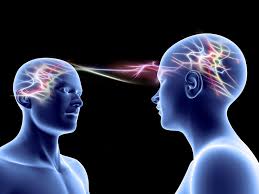
… okay enough of this. Let us move swiftly on to the more pressing question of how the young Ladies and Gentlemen depicted below manage to communicate ideas from one mind/brain to another without any evident physical means. Its connection with earlier questions should be evident – I hope.

The film The Village of the Damned is an effective horror film. Indeed, the original 1960 low-budget version (directed by Wolf Rilla) is widely regarded as one of the most viscerally frightening films ever made, up in the same league as The Exorcist (1973).
However, we have to go to the original novel, The Midwich Cuckoos (1958), to get a clearer picture of what the Children (with a capital ‘C’) are really capable of. When I tell you that the author of this novel is John Wyndham, and that it is essentially the evil twin of his more hopeful (but much less well known) earlier novel The Chrysalids you will see why these blonde creatures are of particular interest to me, and should also be to you.
So, how does the telepathy trick work? (Obviously, it is a trick of some kind, for we are clearly within the realms of science fiction, are we not …? At least we hope so, for the Children clearly present a very real existential threat to Homo sapiens.
Exactly why they are frightening is complex, but includes the fact that, unlike the original eponymous Chrysalids, these Children clearly had an extraterrestrial origin, and could also exert a powerful and malign kind of mind-control over ordinary humans. This is irrelevant to the idea of telepathy itself, however, and so shall be disregarded here.)
Well, it just might be that it (i.e. the telepathy trick) is no more amazing and bizarre than is your ability to process information from a complex auditory wave form, one where the original pattern is utterly submerged, thus giving hope to all wannabe Chrysalids.
However, if one of the Boys is put into one lead-lined container thick enough to prevent the leakage of anything currently known to physics (disregarding any quantum funny business involving nonlocality, of course), and another Boy is put into another, and it turns out that they can still communicate, then we are sunk. The situation is magical, even if conceptually possible.

So, all we need to do now is to explain more clearly the difference between conceptual possibility and causal possibility (and a few other types of possibility as well, while we are at it). But let us leave that to another occasion …
… in the meantime, I leave you with the thought that contemporary British culture recognizes more than one type of magic. Apart from Harry Potter, we also have Jonathan Creek whose magic is altogether more impressive since he always tells you how the trick is actually done. As shall I – eventually.

Sleep well.
(PS If you dream in technicolor, you might want to visit my Colour and Consciousness page, somewhere on this blog … but I can’t guarantee that you really are dreaming.)
 Philosophy and telepathy: an open discussion